
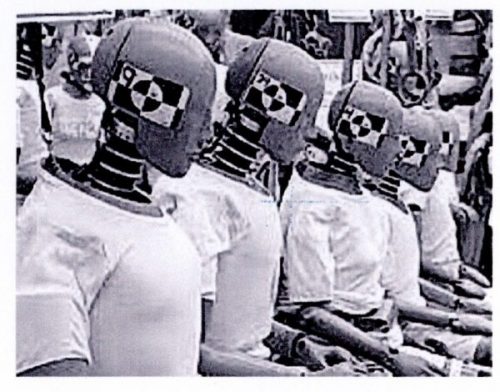

A child is not a dummy. A real child has a fragile skeleton and an articulated pelvis which is disproportionately smaller than an adult’s and composed significantly of elastic cartilage. It lacks the height, definition and integrity to reliably ‘hook’ the seat belt or to assume the brunt of the forces of a collision on its own.
When a child slouches, her pelvis rotates counter-clockwise (backwards) reducing the height and decreasing the vertical slope of the spines on either side, thus diminishing its capacity to engage the belt to absorb collision forces and resist submarining.
For the pelvis to play its role in protecting the viscera of the child, it depends upon sufficient downward reaction force in the lap belt to grip the upper thighs, to ensure the belt does not ride up over the pelvic spines to penetrate the soft abdomen; the downward force also augments the friction between the child and her seat to reduce the forward inertial loads on the pelvis.
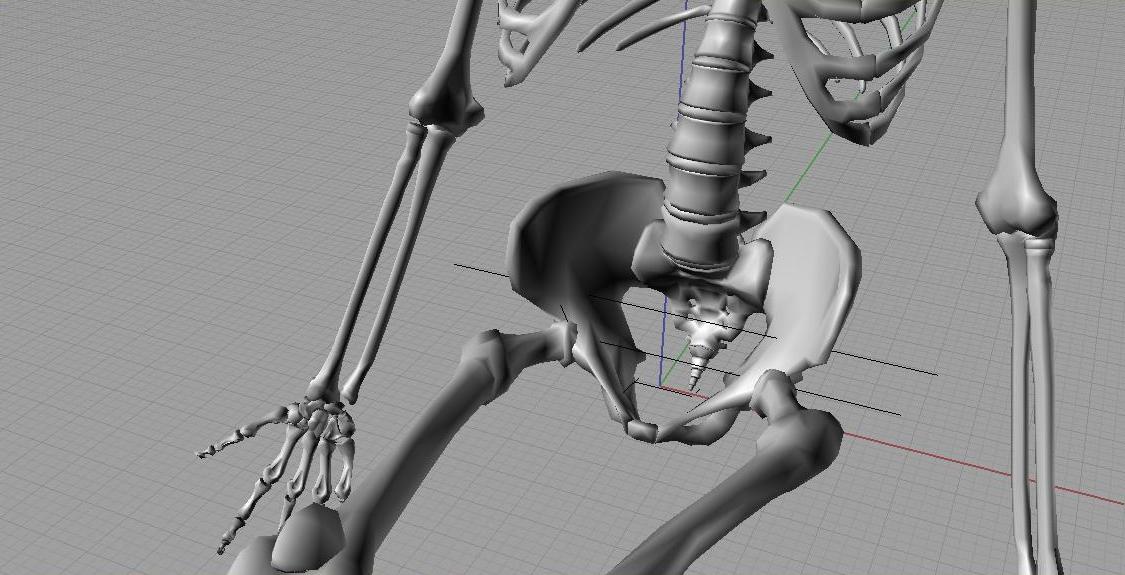

This downward reaction force depends upon the preservation of an adequate belt angle.
It is the vertical angle assumed by the lap belt during a collision more than any prior ‘static’ belt fit that is the key parameter for the preservation of proper pelvic orientation in a collision.

The vertical angle assumed by the lap belt in a collision, not its static fit, is the key parameter of lap belt performance.
Too shallow an angle and there is not enough downward pressure in the belt on the hips and a risk inertial forces will make the child ‘submarine’, exposing her abdomen to the lap seat belt.
Belt-positioning booster seats extend lap and shoulder belts, increasing free forward movement in a collision. This along with compression of the vehicle seat degrades lap belt angle and reduces the magnitude of the downward reaction force essential to stabilizing the pelvis.
More generally, the extended belts characteristic of the belt-positioning booster seat:
- increase the risk of the head of the child impacting the vehicle interior;
- increase the magnitude of the impulse the lap seat belt exerts on the pelvis (or abdomen) at the limit of its extension;
- reduce the overall benefit of the energy-absorbing capacity of the vehicle.